
Search engine ranking reports are useful when a position change leads to a defensible decision. A green arrow alone is not enough. You need to know the keyword, search location, device, observation date, ranking URL and measurement method before deciding whether a movement deserves action.
Start with this fictional result: a service keyword moved from position 8 to 5 on mobile, while another moved from 4 to 9. Calling the campaign “up three positions” would hide the problem. This guide shows how to read the individual rows, preserve uncertainty and write a report that assigns the right work.
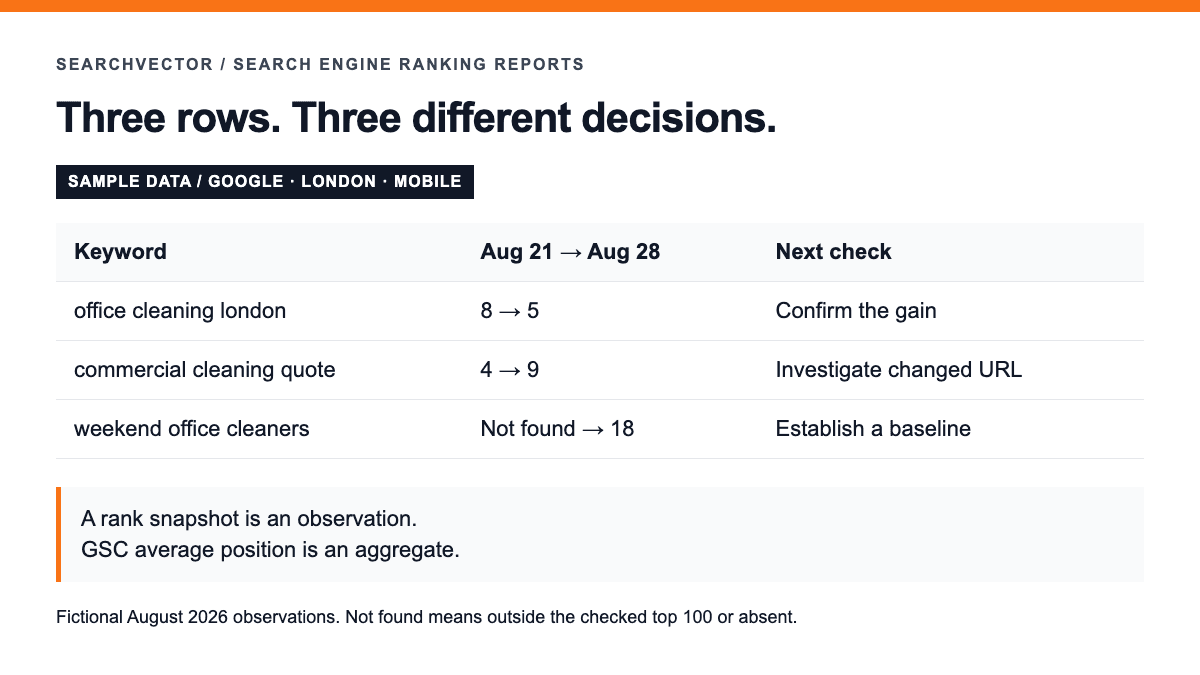
An annotated ranking report
Sample scope: Google organic results; London, United Kingdom; mobile; English query set; observations on August 21 and August 28, 2026, at 09:00 UTC. The example search depth is 100 results. These are invented observations for example.com, not a live SearchVector report.
| Keyword | Aug 21 | Aug 28 |
|---|---|---|
| office cleaning london | 8 | 5 |
| commercial cleaning quote | 4 | 9 |
| weekend office cleaners | Not found | 18 |
- office cleaning london: the observed URL is /services/office-cleaning on both dates. Position improved by three places. Confirm it persists before calling it a trend.
- commercial cleaning quote: the observed URL changed from /quote to /guides/cleaning-costs. Position declined by five places. Investigate the URL change and search intent together.
- weekend office cleaners: /services/weekend-cleaning now appears at 18. The earlier observation was outside the checked depth or absent, not a measured position of 101. Report “newly observed,” not an exact 83-place gain.
The example uses previous rank minus current rank, so a positive number means improvement. Some exports reverse that convention. Put the formula in the report legend and label gains and declines with words as well as color.
The fields that make a row interpretable
Retain the exact query, intended landing page, observed landing page, search engine, country or city, device, language, timestamp, checked depth and result type. Country-level checks and city-level checks are not interchangeable. A mobile organic result and a local map listing should not be placed in the same position column without an explicit definition.
Keep failed retrievals separate from successful searches where the domain was not found. A timeout means “not checked”; an out-of-range result means “not observed within depth.” Both differ from a confirmed decline. Otherwise an outage can generate a false loss report and a misleading rebound the next day.
For a quick additional observation, use SearchVector's keyword rank checker with the settings it offers. Save the time and configuration of that check. A fresh lookup provides another observation; it cannot recreate a missing historical measurement.
Rank snapshot versus Search Console position
| Measurement | Interpretation |
|---|---|
| Tracked rank snapshot | Where a result appeared during a particular check under specified settings |
| GSC average position | An aggregate of observed topmost positions across impressions in the selected report scope |
Google explains that Search Console's average position is based on the topmost result from your property or page, depending on aggregation, across recorded impressions. It is not a daily lookup for a fixed keyword list. See Google's position and impression definitions.
Consider a simplified sample with 100 impressions at position 2 and 900 at position 10. The impression-weighted average is (100 × 2 + 900 × 10) ÷ 1,000 = 9.2. If the mix changes to 500 impressions at each position, the average becomes 6.0 even though neither underlying position changed. This arithmetic example illustrates why an aggregate improvement can result from a different mix of searches.
A tracker might show position 5 at one moment while GSC shows 7.4 for the period. Both can be consistent with their definitions. Align query, page, device, country and dates before investigating a discrepancy. GSC country data cannot reproduce a specific city check, and a period average cannot reproduce one timestamp. Do not “correct” one source by overwriting it with the other.
Segment before writing the summary
Keep a stable cohort of tracked terms for the comparison, and report newly added or removed terms separately. Adding many low-ranking terms can worsen the average without any existing keyword losing ground. Keep a copy of the keyword set or a dated version label with each export.
- Brand versus non-brand: separate people looking for your organization from people searching for the service or problem.
- Commercial versus informational intent: a guide improving does not cancel out a quote page declining.
- Device and location: inspect mobile losses independently from desktop gains, and keep each local market separate.
- Landing page or section: group rows by the page you want to improve, including cases where Google selects a different URL.
- Result type: explain whether the report measures organic links, local results or another placement.
For a stable 40-keyword cohort, suppose 12 were in the top 10 last week and 16 this week. Top-10 coverage rose from 30% to 40%, or 10 percentage points. State that the denominator is 40 successfully checked keywords. If five checks failed, disclose them and avoid silently calculating a comparable-looking percentage on a different denominator.
Use the Search Console performance report for complementary click and impression context. Keep its filters with the export, and acknowledge that detailed query data may be limited. A rank report cannot tell you how much traffic a ranking produced merely by multiplying position by a universal CTR assumption.
Decide what to do with the three sample rows
Position 8 to 5: confirm and protect
Check subsequent observations under the same settings. If the improvement persists and the intended service page still ranks, look for supporting changes in relevant GSC queries and clicks. Record any recent page update as context, not proof that it caused the gain. Avoid rewriting the page simply because the report needs an action item.
Position 4 to 9 with a new URL: investigate
First verify that /quote still loads, is eligible for indexing and presents the intended offer. Then compare the quote page and cost guide against the current query intent. Review canonical signals and internal links. The alternate URL may indicate overlapping content, a changed search results mix or a page problem; two dates do not prove cannibalization.
Assign the SEO analyst to review the current results and the developer to check any confirmed technical fault. Use the title and meta checker to inspect the page's current title when evaluating its promise. Do not use a title change as a substitute for fixing an inaccessible page.
Newly observed at 18: establish a baseline
Confirm the new observation, check that the intended weekend-service URL appears, and keep monitoring the same query. Record the first observed date. You have evidence of visibility within the checked depth, but no measured previous position from which to calculate a precise gain.
Write a report with an action log
A weekly review is a practical starting cadence for editorial decisions; it does not prescribe how frequently your tracking tool must collect data. Review a sustained pattern, and annotate releases, migrations, outages and changes to the keyword set. Investigate urgent accessibility or indexing failures when discovered rather than waiting for the reporting date.
- Observation: quote query moved 4 to 9 and selected a different URL.
- Hypothesis: Google may now prefer informational intent, or the quote page may have an eligibility problem.
- Evidence needed: current result comparison, URL checks and matching GSC page/query data.
- Owner and deadline: SEO analyst, next business day for diagnosis; developer only if a technical fix is confirmed.
- Success check: verify the chosen fix directly, then review the intended URL and position across later comparable observations.
End with the uncertainties that matter: incomplete checks, changed scope and conclusions supported by only one observation. For a broader stakeholder deliverable that combines visibility with traffic and technical work, use the SEO report sample PDF. Keep the ranking appendix's measurement definitions attached so the summary remains honest.