
Download the SEO report sample PDF — four pages with selectable text, a scorecard, page-level analysis, technical findings and an action plan. No form or account is required.
Sample data: every number in the download is fictional teaching data for example.com. No customer, company performance, live crawl or SearchVector account is represented. The report shows how to explain a result and assign work; it is not an automatically generated product export. The HTML preview below contains the same core values and recommendations.
What is in the download?
- Executive summary and measurement scope: what changed, the reporting dates and the decision required.
- Performance detail: comparable totals, page groups and the calculation behind each change.
- Technical findings: affected URLs, confidence and verification steps.
- Action plan and handover: priorities, responsible roles, due dates and completion criteria.
This is a filled example you can adapt, rather than an empty template. For the broader process of assembling a recurring report, see how to create an SEO report. This page concentrates on the actual deliverable and the reasoning a reader should be able to check.
HTML preview: executive summary
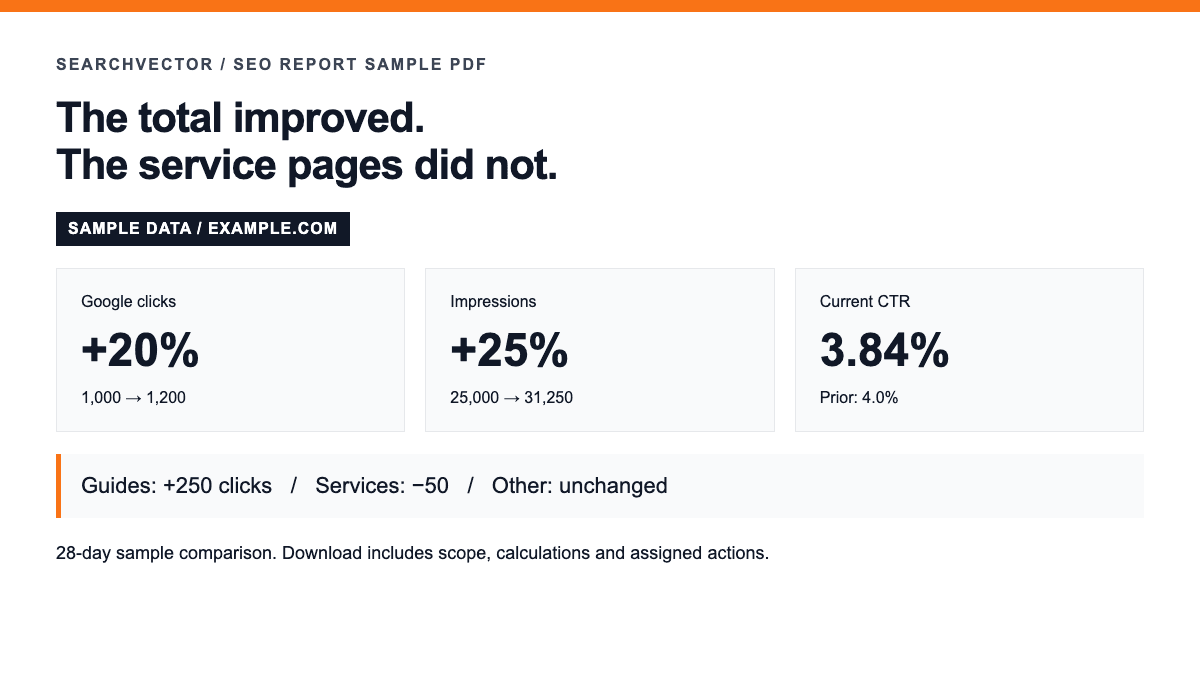
Sample conclusion: organic search clicks grew 20%, while impressions grew 25%. CTR fell from 4.0% to 3.84%. Growth came from the guide section; service-page clicks declined. First inspect the affected service pages and repair confirmed internal links to retired URLs. Do not describe the increase in search clicks as an increase in sales.
The decision is where to spend the next reporting cycle's effort. The guides are generating additional visits, but that does not establish that commercial demand improved. Give the service-page investigation an owner and preserve the guide pages that are already attracting useful queries.
Measurement scope
- Site: example.com, a reserved example domain used here only to label a fictional dataset.
- Current period: August 1–28, 2026. Comparison: July 4–31, 2026. Both cover 28 days with the same weekday mix.
- Search definition: Google Search Console Web search, all countries and devices, no query filter, site-level totals. Dates follow the source report's Pacific Time convention.
- Technical snapshot: a hypothetical August 28 review of 100 HTML URLs; findings are a snapshot, not 28-day traffic metrics.
- Business outcomes: conversions, leads and revenue are not included. No analytics or CRM export underlies this example.
In a real report, replace each scope item with the actual property, filters, export date and crawl configuration. Keep the unfiltered export separately from filtered worksheets. Search Console documents the available report controls in its Search results performance guide.
Scorecard with checkable math
| Metric | Prior | Current |
|---|---|---|
| Google clicks | 1,000 | 1,200 |
| Impressions | 25,000 | 31,250 |
| CTR | 4.0% | 3.84% |
| Average position | 14.2 | 13.1 |
Clicks increased by (1,200 − 1,000) ÷ 1,000 = 20%. Impressions increased by 25%. Current CTR is 1,200 ÷ 31,250 = 3.84%, a decline of 0.16 percentage points from 4.0%. Percentage points describe the difference between rates; the relative CTR decline is 4%. State which one you mean.
Average position moved from 14.2 to 13.1, a numerical improvement of 1.1. It does not mean every keyword rose one place. Search Console aggregates observed positions; the mix of queries and impressions matters. See Google's definitions of clicks, impressions and position and our guide to search engine ranking reports for interpreting that distinction.
Find the page group behind the total
| Page group | Prior clicks | Current clicks |
|---|---|---|
| Guides | 400 | 650 |
| Services | 350 | 300 |
| Other pages | 250 | 250 |
| Total | 1,000 | 1,200 |
The net gain of 200 clicks hides two movements: guides gained 250 and services lost 50. A useful report names both. The sample groups are deliberately exhaustive and non-overlapping so their clicks reconcile. Real exports need an explicit URL grouping rule and a check for truncation, aggregation differences and missing rows.
For the service section, compare the same pages and query groups by country and device. Check whether impressions fell, CTR fell, or both. The available sample does not contain that detail, so the report assigns an investigation instead of inventing an explanation. A lower service-page total alone cannot establish a technical fault, a demand decline or a ranking loss.
Technical findings with a verification step
| Finding | Evidence to retain |
|---|---|
| 8 source pages link to retired URLs | Source URL, link destination and confirmed response status |
| 3 indexable pages share a title | URL, current title, intended topic and canonical target |
These are counts of affected pages, not a count of unique defects across the site. The two sets may overlap, so do not sum them into “11 broken pages.” The sample assigns no causal relationship between these findings and the traffic changes.
For the retired URLs, verify whether a useful replacement exists. Update the internal link to that replacement when appropriate; do not redirect every missing page to the home page. For duplicate titles, inspect whether the pages serve distinct purposes before rewriting them. A duplicate title is an investigation prompt, not proof of a penalty.
SearchVector's title and meta checker can support the page-title review, and the sitemap analyzer can help examine the URL inventory. Record the actual output and collection date in your working file. The example PDF does not claim to be the output of either tool.
The action plan a reader can approve
- September 2: service-page diagnosis, SEO analyst. Compare the same service URLs by query, device and country. Completion means a documented explanation supported by exports, or an explicit unresolved hypothesis.
- September 4: repair confirmed internal links, developer. Recheck all eight affected source pages. Completion means the intended destinations work and the obsolete internal links are removed or corrected.
- September 7: review duplicate titles, editor. Assess all three affected pages. Completion means titles reflect distinct intent, or a documented consolidation decision is assigned for implementation.
These dates belong to the fictional report's action cycle. Replace them when adapting the sample. Do not retain historical deadlines and present them as your team's next steps. Review technical completion separately from search performance; a fixed link can be verified immediately even when traffic impact remains uncertain.
Adapt and check before sharing
- Replace the example domain, dates, roles, findings and every sample value.
- Use identical property, search type and filters for both periods; mention seasonality and major releases.
- Recalculate percentages from totals rather than averaging row-level rates.
- If adding outcomes, define the event and attribution model. Keep search clicks, analytics sessions and CRM leads separate.
- Attach the source export names and explain any unavailable metric. Use “not measured” rather than a fabricated zero.
- Open the exported PDF on a small screen, test its links and confirm that tables remain readable.
A client should be able to answer: what changed, how do we know, what remains uncertain, and who will act? Download the sample report and use those four questions as your final review.