
There is no universal number of SEO keywords to put on a page. Start with one primary search intent, choose a main phrase that describes it, and include supporting terms when they help answer the same question. That is an editorial planning method, not a Google keyword quota. A useful page can address several related searches without repeating every variation.
The practical question is whether those searches deserve the same answer. This guide walks through a fictional coffee retailer's keyword map, then gives you a worksheet for deciding which terms to keep, split, or assign to an existing page.
Separate keyword targets from keyword repetitions
A target keyword is a search phrase you want the page to satisfy. A keyword occurrence is one appearance of a word or phrase in the text. These are different counts. Targeting five related phrases does not mean using each phrase five times, and a page that repeats one phrase can still be a poor answer.
Google's SEO Starter Guide explains that its language matching systems can relate pages to queries even when the exact terms are absent. Treat the main keyword as a clear label for your topic. Supporting language should explain the topic, not satisfy a list of compulsory strings.
For an editorial brief, record one primary phrase and the supporting questions you actually intend to answer. Stop adding terms when they no longer change the outline or improve an explanation. A short product page may need only a few relevant attributes; a troubleshooting guide may need many symptoms and solutions. Neither requires a numerical allowance based on length.
Work through a sample keyword map
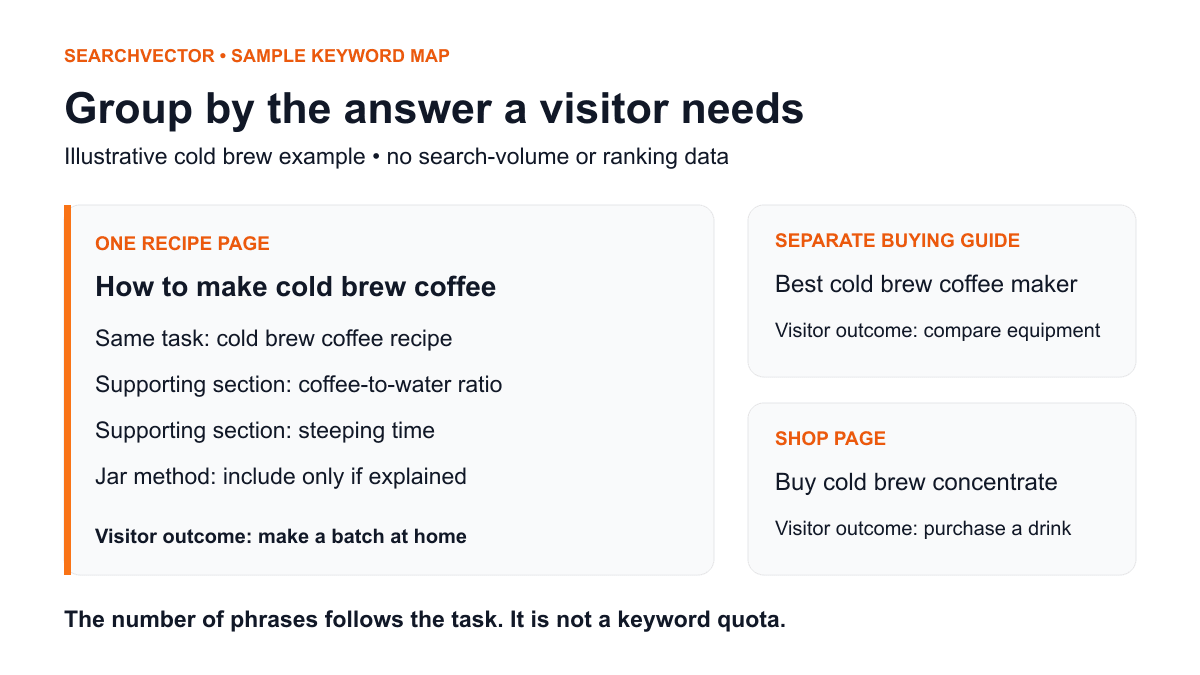
Imagine a coffee retailer preparing a guide to making cold brew at home. Its visitor wants a repeatable recipe, including the amount of coffee, water, steeping time, and equipment. The following phrases are illustrative teaching examples, not measured search demand or observed ranking results.
| Candidate phrase | Page decision | Reason |
|---|---|---|
| how to make cold brew coffee | Main recipe topic | Describes the visitor's complete task |
| cold brew coffee recipe | Same page | Another way to request the recipe |
| cold brew ratio | Recipe section | Needed to measure ingredients |
| how long to steep cold brew | Recipe section | Needed to finish the method |
| cold brew without a coffee maker | Same page if supported | Fits when the recipe actually uses a jar |
| best cold brew coffee maker | Separate buying guide | Requires comparing products |
| buy cold brew concentrate | Relevant shop page | The visitor wants to purchase |
This map assigns five candidate phrases to one recipe and two elsewhere. Five is the outcome of the example, not a recommendation for every page. If the recipe does not explain a jar method, remove that phrase from the brief or genuinely add the method. Mentioning it once would not meet the searcher's need.
The resulting outline is straightforward: ingredients and ratio, equipment, preparation steps, steeping time, and serving instructions. The shopping and product-comparison material would interrupt someone trying to make a drink. A short contextual link can connect those tasks without turning the recipe into three different pages at once.
Before accepting this map for a real site, inspect search results for each phrase in your intended market. A ratio query might favor dedicated reference charts rather than recipes. If that difference is consistent and your recipe cannot provide a convenient answer, reconsider whether it deserves its own resource. The example is a hypothesis to validate.
Decide whether searches need the same answer
Shared words do not prove shared intent. Ask three questions: does the visitor want the same outcome, does the expected format match, and can one page answer both searches without a distracting detour? A definition, a comparison, and a checkout page can all contain the same product name while serving different needs.
Compare several relevant results, looking at their actual content rather than titles alone. Note whether they are tutorials, category pages, product listings, or specialist explanations. Repeated overlap among useful results is evidence for grouping. Different formats or audiences suggest a split. There is no universal overlap percentage that makes the decision for you.
Ambiguous phrases need a narrower promise. For example, “cold brew coffee” could describe a drink, a recipe, or a product. Choose the audience and task your business can serve well, then make the title and opening specific. Trying to cover every interpretation often produces a page that is inconvenient for all of them.
Use SearchVector keyword research to explore candidate language before making the map. Review the suggestions yourself and discard irrelevant terms. A research result supplies a candidate, not proof that it belongs on your page or that a new URL is necessary.
Fill in a page-mapping worksheet
Copy these fields into your content brief or spreadsheet. Complete the visitor task before choosing a primary phrase. For an existing site, search your own content inventory first so the worksheet can point to a page that already does the job.
| Field | Example entry |
|---|---|
| Visitor and task | Home coffee drinker making a first batch in a jar |
| Preferred page | The existing cold brew recipe, updated where needed |
| Primary phrase | how to make cold brew coffee |
| Supporting questions | Ingredient ratio, steeping time, jar method |
| Evidence to include | Clear measurements, preparation steps, and an accurate equipment list |
| Outside this page's scope | Appliance comparisons and purchasing concentrate |
| Reason to revisit | Relevant queries reveal a question the recipe does not answer clearly |
Add an owner and review date in your working copy. Where a decision is uncertain, record what you need to check, such as whether a dedicated ratio chart would be more useful. This makes the map reviewable instead of leaving the writer with an unexplained pile of keywords.
Place terms where they help the reader
Give the page a descriptive title and main heading. Introduce its answer promptly. Use subheadings to label actual steps or questions, and use relevant terminology when describing ingredients, features, examples, or limitations. You do not need an exact-match phrase in every heading.
In the sample recipe, a heading such as “Coffee-to-water ratio” helps someone find measurements. Repeating “How to make cold brew coffee” above the equipment list, timing advice, and serving instructions would make navigation worse. Use image alt text to describe the image's useful information, rather than storing spare keywords there.
Write the meta description as an accurate summary of the page's benefit. After editing, SearchVector's title and meta checker offers a place to review those page elements. A readable title and summary still need an underlying page that delivers their promise.
Avoid density targets. Keyword density counts occurrences relative to text length; it does not measure whether you answered the visitor's question. Google's keyword stuffing policy identifies unnatural repetition and out-of-context keyword lists as manipulative practices. Edit an awkward passage for clarity instead of adding repetitions to reach a percentage.
Review existing pages before creating more
If two URLs address the same task, compare their coverage and intended audiences before commissioning another article. Perhaps one needs updating, or each needs a clearer purpose. Two pages appearing for related searches does not automatically establish harmful keyword cannibalization, the situation where overlapping pages interfere with your preferred search destination.
Use your own Google Search Console Performance report to inspect queries and pages with consistent date, country, device, and search-type settings. Start with the preferred URL's queries, then investigate which pages appear for an important query. Google's Performance report guide explains these dimensions. Keep your filters with any notes so later comparisons mean the same thing.
Look for a practical mismatch: a shop page appearing where users need instructions, or an older thin article receiving visibility for a question covered better elsewhere. Query rows are evidence to investigate, not a complete inventory of potential demand. Avoid rewriting a useful page because a phrase is absent from one reporting window.
If the preferred page already serves the intent, improve its missing section and link to it from relevant pages. If two articles substantially duplicate the same job, review consolidation with whoever manages the site, preserving valuable information and planning redirects where appropriate. If the tasks differ, retain both and make that distinction clear in titles, content, and internal links.
Make the final keyword decision
Before handing a brief to a writer or publishing an update, check:
- Can you state the page's visitor task in one sentence?
- Does each supporting term earn its place through useful content?
- Have you separated materially different buying, learning, or comparison tasks?
- Have you checked whether an existing page already owns the answer?
- Do the title, opening, headings, and internal links describe the same purpose?
- Does the prose read naturally without a density target?
For your next page, choose one main intent, map the related questions, and write the answer those questions deserve. Keep the supporting phrases that strengthen that answer. Move the rest to a better destination or leave them out. The finished keyword count should follow the page's usefulness.