
Reciprocal links are links between two websites in both directions: your site links to another site, and that site links back to yours. For SEO, the important question is why each link exists. Two useful editorial citations can happen naturally. A campaign that trades links primarily to influence rankings needs a different response.
Before accepting an exchange, ask three questions: would each link help its reader without a return link, is either placement conditional or compensated, and have you inspected both actual pages? Start with those checks, not a target percentage of reciprocal backlinks.
Recognize the two-way pattern
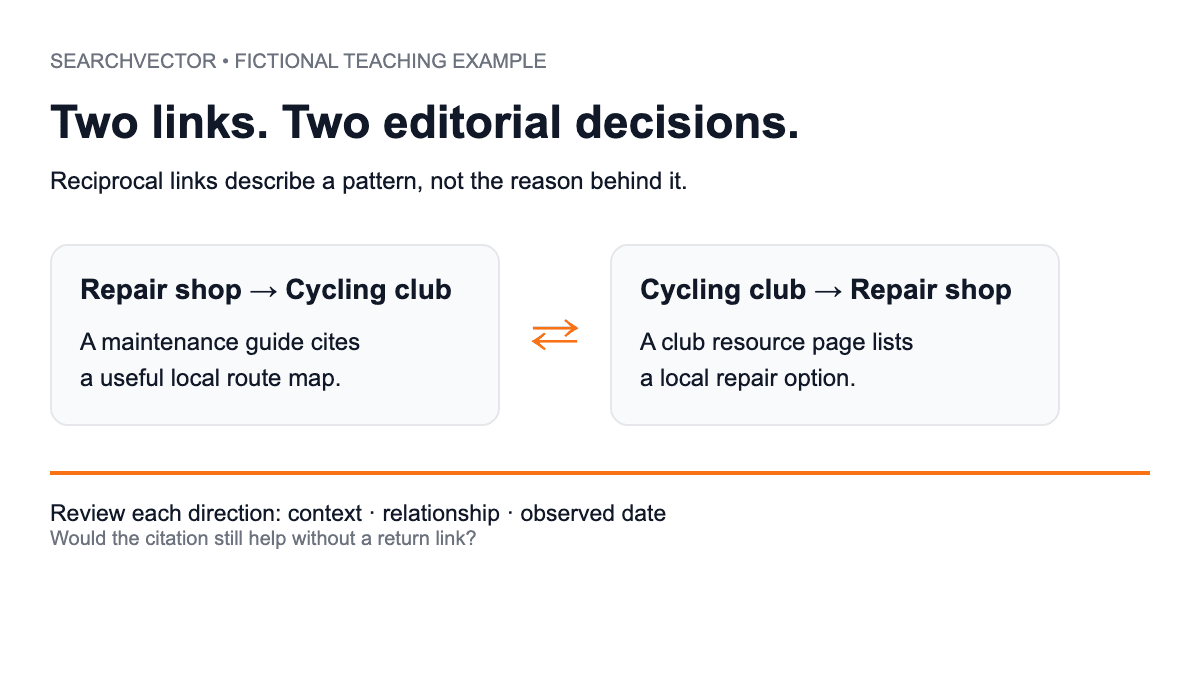
Reciprocity can exist at domain level without the same two pages linking directly to each other. A repair shop might cite a cycling club's route guide, while the club's maintenance page lists that shop. Record the exact source and destination for both directions before describing the relationship.
Keep three observations separate: a link is visible, a return link is visible, and the publishers agreed to exchange links. The first two are page evidence. The third needs relationship evidence, such as an agreement or correspondence. A backlink report alone cannot establish editorial intent.
An internal link connects pages on the same website. It is a different task. If your review uncovers confusing navigation within your own site, use SearchVector's Internal Links Checker for that separate review, rather than treating internal navigation as a reciprocal-link exchange.
Where Google draws the policy line
Google's link spam policy addresses links created primarily to manipulate rankings. It includes excessive exchanges and partner pages made solely for cross-linking. Policy violations can lead to lower visibility or removal from results, but finding a two-way pair does not establish an automatic penalty.
Google provides no universal safe exchange percentage in that guidance. Evaluate purpose and context instead of treating a low ratio as permission. Moving an arranged exchange through a third website does not resolve a ranking-manipulation purpose.
Use this editorial test: if the other publisher removed its link tomorrow, would you still choose to send readers to its resource? A yes is a useful starting point, not proof of policy compliance. Inspect the resource, the commercial relationship, and any wider campaign before deciding.
Review a fictional cycling partnership
Imagine that you edit a bicycle repair shop's website. A local cycling club offers to mention the shop. Your maintenance guide already cites the club's route map because readers need suitable places to test a repaired bicycle. The following scenarios are fictional teaching examples, not observations of real businesses or measured SEO outcomes.
| Situation | Evidence to inspect | Decision |
|---|---|---|
| Independent references | The route map helps customers; the club independently lists local repair options. | Keep useful citations after checking accuracy and relationships. |
| Conditional exchange | The club demands a keyword-heavy link before it will publish your listing. | Decline the condition; offer an independently reviewed resource. |
| Paid sponsorship | The shop pays to sponsor a club event and receives a sponsor link. | Disclose the sponsorship and qualify the paid placement. |
For the independent references, inspect the surrounding sentences. Does “local route map” accurately describe the destination? Does the club explain why the shop appears in its repair directory? Check that both destinations still contain the promised information. Shared geography alone does not make every link useful.
For the conditional exchange, save the request and avoid publishing simply to unlock a backlink. You could still consider the route map on its merits, without promising a return placement. If the map is no longer useful, remove the citation for that reason, not as retaliation for a missing backlink.
For the sponsorship, treat the commercial arrangement as a distinct relationship. A genuinely useful event listing can still be paid. Reader usefulness and link qualification answer different questions; one does not replace the other.
Qualify links for the actual relationship
Google's outbound-link documentation says ordinary editorial links need no special rel attribute. Use rel="sponsored" for advertisements or paid placements; nofollow remains acceptable for those links. Use ugc for user-generated links, such as forum contributions.
Use nofollow when the other values do not apply and you do not want Google to associate your site with the linked page. These attributes do not prevent the destination from being discovered elsewhere. “Dofollow” is industry shorthand, not an attribute you need to add to an ordinary link.
These escaped HTML examples show the difference between an editorial citation and a sponsor placement. The reserved example domains are illustrative destinations, not resources to visit.
Editorial citation: <a href="https://club.example/routes">local route map</a>
Paid placement: <a href="https://shop.example/" rel="sponsored">event sponsor</a>
Choose the relationship first, then the markup. Do not use a tag as a substitute for reviewing an irrelevant placement or as a promise that a link campaign is safe. Decline proposals whose central purpose is trading ranking credit.
Build a review record you can recheck
Create one observation for each direction. A single row saying “partner link confirmed” hides which page you inspected and what you actually saw. Use these fields in your placement log:
- Source and destination: save both full page URLs, including any final destination after a redirect.
- Anchor and context: copy the visible link text and describe the surrounding paragraph or listing.
- Observed markup: note the relevant
relvalues from the inspected link. - Observed date: record when you checked it, separately from a claimed publication date.
- Relationship: note independent citation, sponsorship, requested exchange, or unknown, with supporting evidence.
- Decision and owner: assign keep, qualify, remove, decline, or investigate, and name the person responsible.
SearchVector's Backlink Records provides a place to document source URL, destination URL, anchor, dates and notes. Use notes for your observation date and editorial decision. Recording a placement is not the same as discovering backlinks, automatically checking both directions, or detecting a scheme across the web.
If a page is blocked or unavailable, mark the observation as unverified. Do not turn a failed fetch into “link removed.” Likewise, a saved HTML snippet describes that snippet; it does not prove what every visitor or crawler currently receives.
Recheck the specific evidence that led to the decision. If an editor promised to qualify a sponsorship link, inspect that link after the change. Keep the earlier observation so another reviewer can understand what changed, without relying on memory.
Respond to an exchange request
A useful response keeps control with the editor: “We review references for their usefulness to readers and cannot promise a return link. Send the exact resource and explain which part of our article it helps.” This invites a relevant contribution without creating a placement obligation.
Then inspect the resource yourself. Look for a specific improvement: a maintained route map, an original measurement method, a repair checklist, or an authoritative explanation. A generic homepage pitch gives you less reason to interrupt a reader's task.
If the request involves payment, products or services, ask for the commercial terms before approving anything. If the requester insists on ranking-focused anchor text or refuses appropriate qualification, decline. Keep the decision with the person accountable for the page's accuracy.
Replace exchange targets with editorial goals
Give your team a goal it can defend: make a resource another editor would choose even without receiving anything back. For the repair shop, that might mean a model-specific maintenance checklist with clear limitations and a named reviewer. For the club, it might be a route guide with useful access information.
Collaboration can improve either resource. Invite a specialist to check facts, correct a broken reference, or contribute original explanation. Agree on attribution and disclosure, while leaving each publisher free to decide which links belong on its own page.
Evaluate resulting visits and reader actions if you have appropriate analytics, but do not attribute every ranking change to a link. Content updates, technical changes and other activity can overlap. The immediate success criterion for this review is a documented, defensible editorial decision.
Make the next link decision
Choose one exchange request or existing two-way relationship. Inspect both pages, record the relationship evidence, and decide whether each citation deserves its place independently. Qualify commercial placements appropriately and decline arrangements built around trading ranking credit.
You do not need a universal reciprocity score to do this well. You need a clear reason for the link, accurate markup, and an observation someone else can verify.