
To get dofollow backlinks, publish something another writer has a reason to cite, find pages where that resource helps the reader, and offer it to the editor. The publisher decides whether to link and how to qualify the relationship. “Dofollow” is conventional SEO terminology: an ordinary link does not need a special dofollow attribute.
Start with a useful reference, not a promised quantity of links. A citation can send relevant visitors and help people discover your work, but inspecting its HTML cannot tell you how much ranking credit Google will assign it. This guide follows one fictional resource from publication through outreach and verification.
Read the link before labelling it
Here is a controlled HTML example, not a placement on a real publisher’s website:
<a href="https://example.com/checklist">Maintenance checklist</a>
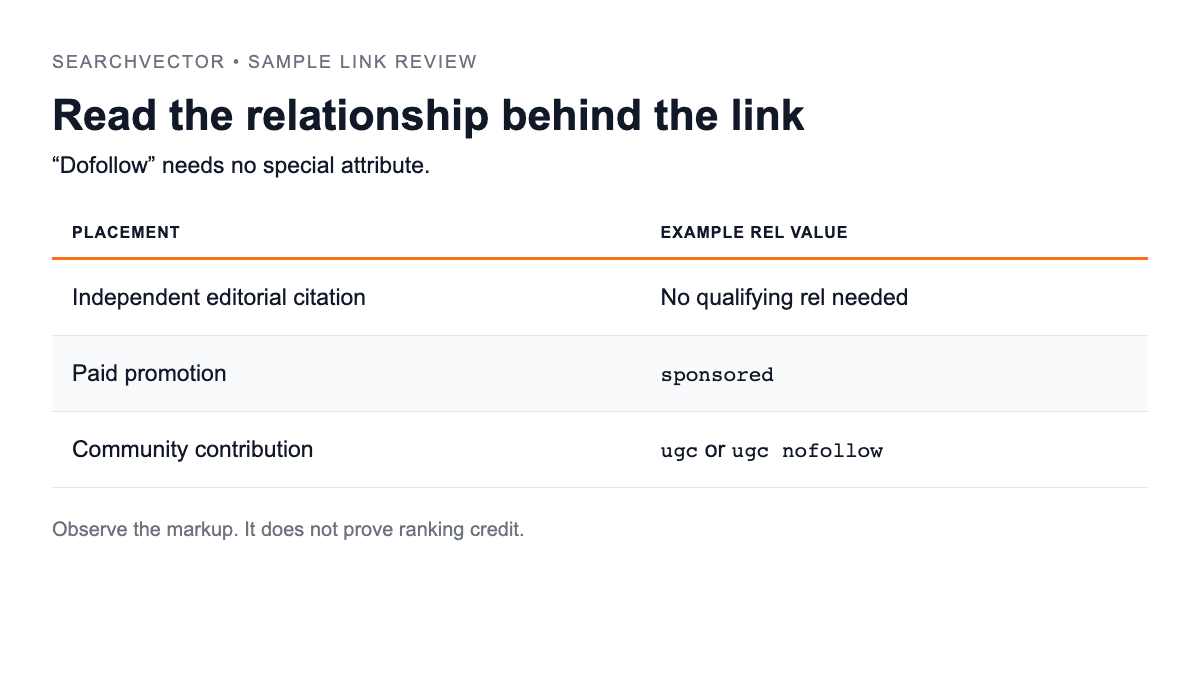
The destination is in href; the words between the tags are the anchor text. There is no rel attribute here. Google’s outbound-link documentation says regular links need no relationship annotation. Adding rel="dofollow" is unnecessary.
| Markup | Meaning for your review |
|---|---|
| No qualifying rel | An ordinary link, often called followed. No ranking outcome is established. |
rel="sponsored" | Advertising or another compensated placement. Google prefers this value for paid links. |
rel="ugc" | A link in user-generated content, such as a forum contribution. |
rel="nofollow" | A qualification used when other values do not fit and the publisher does not want Google to associate the linked page with its site or follow that link. |
Values can be combined. A link with rel="ugc nofollow" carries both qualifications; finding one token is not a reason to ignore the other. Google also accepts nofollow for paid links. These attributes are not an indexing-control system for the destination: another route may lead Google to that page.
Give an editor something worth citing
Choose a resource you can maintain and defend. A reproducible calculation, a clearly documented experiment, a specialist checklist, or a useful explanation of a confusing procedure can each earn attention. The key question is specific: which sentence in someone else’s article becomes more useful when it points to your work?
Make the destination independently useful. Put the answer on the page, explain your assumptions, identify the author or responsible team, and show where the information came from. If you publish original data, include collection methods, exclusions and limitations. A graph with unexplained numbers asks an editor to trust you without giving them a way to check.
- Original evidence: publish a small, well-defined observation with the method needed to interpret it. Do not describe a convenience sample as an industry benchmark.
- Reusable instructions: make a checklist or worked calculation that solves a real task more clearly than the surrounding article can.
- Accurate corrections: explain a broken reference or outdated instruction and offer a relevant replacement only when yours actually fills the gap.
- Unlinked attribution: where a writer already credits your research, ask whether linking the original would help readers inspect the method.
Free access can reduce friction, but “free backlinks” still take research and maintenance. Posting your URL into every directory or comment form gives you little control over whether the placement helps anyone.
Worked example: a maintenance checklist
Imagine you run a bicycle workshop and publish a printable pre-ride maintenance checklist. This is a fictional teaching scenario, with no claimed outreach results. The checklist explains each inspection, identifies situations requiring a mechanic, and includes a printable version without an email gate.
You find three candidate pages during ordinary editorial research. Instead of sorting them by a third-party authority score alone, read the passage where a citation might belong.
| Candidate | Decision and reason |
|---|---|
| A local cycling club’s beginner ride guide | Consider outreach: its pre-ride section could use a practical checklist. |
| A general coupon page offering paid followed links | Reject the ranking-link offer: the placement lacks a reader-led reason. |
| A cycling forum member asking about a specific fault | Answer only within your competence and follow the community rules. Accept its UGC qualification. |
For the club guide, confirm that the resource adds something beyond what is already there. If its existing checklist is clearer or more complete, there is no useful pitch yet. Improve your own resource or select a different task. Relevance is not permission to send a generic request.
Before outreach, have someone unfamiliar with your business try to find and understand the checklist. A citation to a confusing destination creates extra work for the editor and their readers. Also check that the printable version actually opens and matches the instructions on the page.
Write the request around the reader’s task
Use the publisher’s stated contact route and respect submission rules. Your note should identify the exact passage, the gap you noticed and the material you can supply. Explain any commercial relationship honestly.
Your beginner ride guide asks members to inspect their bikes before departure. We made a printable checklist that expands those checks and explains when to ask a mechanic. If it would help that section, you are welcome to review it and cite the resource. I work with the workshop that created it.
This sample deliberately leaves the editorial decision with the publisher. In an actual message, provide the resource URL and identify the relevant guide. Do not demand a followed link, prescribe a sales-heavy anchor, or make a citation a condition of providing information. One relevant, courteous follow-up can be reasonable; respect a refusal or silence rather than repeatedly pressing for a response.
If the editor proposes a paid promotion, assess it as advertising. Do not negotiate removal of sponsored or nofollow attributes to obtain ranking credit. The commercial value of reaching the right audience is a different question from whether a link is followed.
Verify the published placement
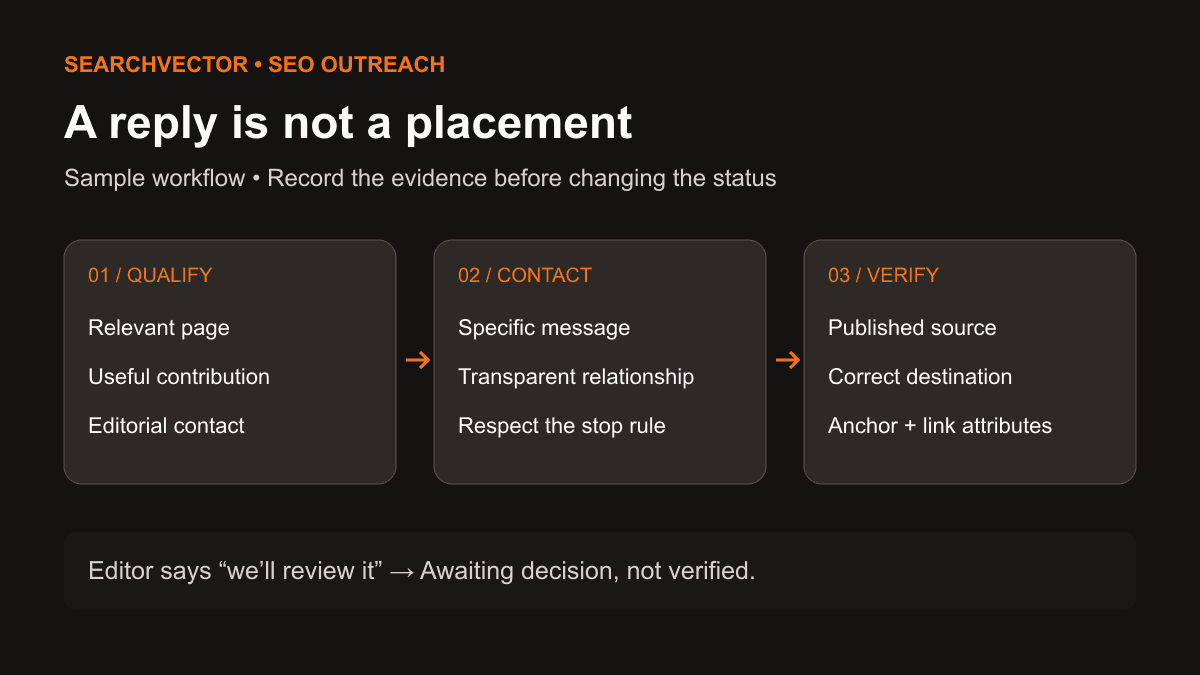
When an editor says the reference is live, open the actual source page. Search for your resource name and inspect the visible link using the browser’s developer tools. An email promise, screenshot or plain-text URL is insufficient evidence of a working hyperlink.
- Confirm the destination. Read the anchor’s href, open it, and note redirects. Make sure it reaches the intended resource rather than your homepage or a broken URL.
- Read all relationship values. Record the complete rel value as observed. Write “none on anchor” when absent, rather than recording “Google credit confirmed.”
- Read the surrounding passage. Check that the link supports the sentence and that the anchor accurately describes the destination.
- Check the rendered page. A script may insert or change a link after loading. Record which version you inspected and any differences from page source.
- Save the evidence. Record source URL, destination, anchor, observation date, relationship values and any disclosed payment or exchange.
Google’s link best practices describe an anchor element with a resolvable href as the usual crawlable format. A clickable-looking button alone is not the same evidence. Page-level directives and access restrictions may require separate investigation; anchor inspection is a narrow check.
For ongoing documentation, SearchVector backlink records let you keep a source, destination, anchor, publication dates and notes. Put the observed rel values and inspection date in your notes. Maintaining a record does not itself crawl the source, detect a lost link, or establish how Google treats it.
Avoid shortcuts that change the relationship
Google’s link-spam policy covers buying links for ranking purposes, excessive reciprocal exchanges and automated link creation. Compensating someone with a product or service can also create a paid relationship. Relevant subject matter does not make a ranking-link purchase compliant.
The same judgment applies to guest contributions and links inserted into older articles. A useful contribution is not a blanket exemption for keyword-heavy anchors or paid ranking placements. Judge what is being exchanged and why the link exists. Keep advertising appropriately qualified, and reject offers to disguise its nature.
Two sites may naturally cite one another’s useful work. Avoid turning that into a quota, reciprocal-link condition or network built mainly to influence rankings. If the link would have no purpose without the expected SEO benefit, reconsider the proposal.
Finish with a useful resource and a verifiable record
For your first pass, pick one resource, find a small set of genuinely relevant publishers, and write down the reader problem for each. Contact only the ones where you can articulate that fit. After publication, inspect and record the actual placement. Recheck it when the source changes or when you review the resource, rather than assuming a permanent link.
Accept that a useful nofollow or UGC citation can still introduce the right readers to your work. Track referral visits and relevant inquiries where you have measurement access, but do not attribute a later ranking change to one link without stronger evidence.
Keep your resource discoverable from your own relevant pages too. The SearchVector Internal Links Checker is a starting point for reviewing those connections. External citations and internal navigation serve different jobs; both should lead people to an answer they can use.