
To track search engine rankings, choose a small set of business-relevant keywords, fix the search engine, country and device, record the ranking URL and observation time, then repeat the same check. Review sustained movement alongside clicks and landing-page performance. A ranking without its search context is difficult to compare reliably.
Start with this setup checklist: keyword set, intended landing pages, engine, country or supported local area, device, language, observation source, and review cadence. Use SearchVector's search engine ranking report guide to structure a consistent observation log. Record the search context and timestamp with each observation. For ongoing account-based work, open the SearchVector rank tracker and confirm the options available in your project.
Build a keyword baseline you can maintain
Start with the queries that help you decide what to improve. For a business selling running shoes, “trail running shoes” might map to a category page, while “how to choose trail running shoes” maps to a buying guide. Track them separately because their search intent and useful landing pages differ.
Use your existing query data and customer questions to choose an initial set. If you need additional ideas, use SearchVector keyword research, then assess each suggestion against your actual products and content. A large search volume does not make an irrelevant query a useful target.
Assign each keyword an intended landing URL, topic group and priority. Separate branded searches from non-branded discovery terms. Keep a dated baseline list so adding easier keywords later cannot silently improve your reported performance. New keywords can join a new cohort while the original cohort continues unchanged.
Define exactly what each check measures
A search engine results page, or SERP, is an observation under particular conditions. Write those conditions once and preserve them with every result. If you change providers or settings, mark a new baseline instead of joining the two series as though nothing changed.
| Field | What to record |
|---|---|
| Query and target | Exact keyword, domain and intended landing URL |
| Search scope | Engine, country or supported location, language and device |
| Measurement | Source, organic-result definition and checked depth |
| Timing | Observation timestamp with time zone; retrieval time if different |
| Outcome | Observed URL, position, result status and relevant SERP features |
Organic links, paid advertisements and local map results are different surfaces. Decide which one your series measures. Do not count every visible block as an ordinary organic position or combine a local-pack position with a web-result position. Google explains its own position-counting rules in the Search Console metric definitions; another provider may use a different convention.
Manual searching is useful for inspecting page formats and result layouts, but it is a weak historical record unless you preserve context. A private browser window does not fix your location, device or language. Google's explanation of differing search results identifies several reasons two people can see different results. Treat your manual search as a separate observation, not a correction to overwrite the tracker.
Record missing checks without inventing ranks
Keep successful observations, out-of-range results and failed checks distinct. “Not found in the first 100 organic results” means the source checked that depth without finding the target. It does not establish rank 101. A timeout means the observation failed; it says nothing about visibility.
Use a status field alongside the numeric position. Leave position empty for unavailable data. Record a reason such as timeout, incomplete response, unsupported location or not found within checked depth. If returned country or device metadata conflicts with your requested settings, quarantine that observation from the trend until you can resolve the mismatch.
Also distinguish fetch time from observation time. A result retrieved today may describe an earlier SERP if the provider returns stored data. Do not label it today's ranking without checking its timestamp. Keeping these fields takes little effort and prevents a surprisingly convincing false trend.
Worked example: a URL switch and a failed check
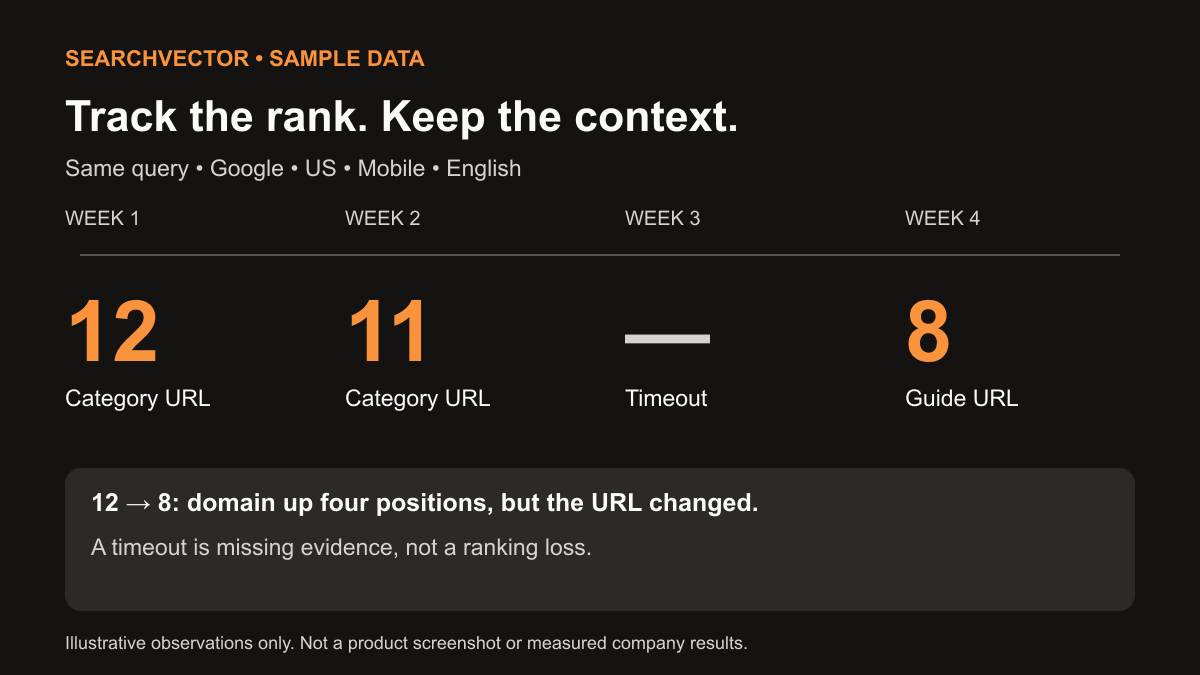
Imagine a fictional retailer tracking “trail running shoes” on Google, United States, mobile, English. The intended page is /trail-shoes. Each scheduled check uses the same source and organic-result definition. These are sample observations for teaching, not company results or a SearchVector product capture.
| Check | Position | Observed page or status |
|---|---|---|
| Week 1 | 12 | /trail-shoes |
| Week 2 | 11 | /trail-shoes |
| Week 3 | Unavailable | Timeout; no observation |
| Week 4 | 8 | /guides/trail-shoes |
At domain level, the latest successful observation is four positions higher than the first: 12 minus 8 equals 4. That does not show that the category page improved. A different URL now ranks. Nor does the missing third check prove a temporary disappearance.
The next task is to inspect intent. Does the current SERP favor buying guides, categories or a mixture? Is the guide genuinely the better answer, or does it obscure the product range? Inspect both pages before calling the switch cannibalization. Multiple related pages can be useful; a URL switch alone does not justify deleting or redirecting one.
Suppose the guide gives useful selection advice but makes the product category difficult to find. A reasonable hypothesis is that a clear contextual link could help interested readers reach the products. Add that link where it helps the reader, record the change date, and review later observations plus relevant landing-page outcomes. Do not claim the link caused a ranking change merely because the change came first.
Compare Search Console in a separate view
Google Search Console measures your site's actual search exposure. Its average position is the average position of the topmost result for the relevant grouping. A tracker observes a chosen query under a specified search setup. Those are different measurements, so disagreement is not automatically a broken tool.
Open the Performance report, choose the search type, select a complete date range, and filter to the query, country and device you are investigating. Add a page filter when assessing a particular landing page. Google's Performance report guide documents the available dimensions and metrics.
Keep clicks, impressions, click-through rate and average position together in that view. Avoid replacing your observation-log values with Search Console averages. If position improves while clicks decline, inspect exposure and the result layout before declaring success. Use consistent filters and comparable periods for the follow-up.
Choose a cadence and an action rule
For a small stable site, a weekly review is a practical starting routine. For a migration, important launch or unstable query set, you may want more frequent observations. These are editorial workflow suggestions, not guarantees about any provider's refresh schedule. Check actual update timestamps and your account's supported settings.
Decide in advance what deserves investigation. One sensible starting rule is to review a substantial decline that persists across two comparable successful observations, an unexpected landing-page switch, or movement affecting several priority pages. The threshold should reflect your site's normal variation and business priorities. A missing-data alert should trigger a collection check rather than an SEO rewrite.
Do not wait for a second ranking observation if you already have direct evidence of a serious failure, such as an important page returning an error or becoming inaccessible. Google’s traffic-drop investigation guide helps distinguish technical problems, seasonality and other causes. A rank chart identifies where to investigate; it rarely establishes the cause by itself.
Finish each review with a written decision
- Validate the observations. Check timestamps, scope, successful-check coverage and URLs before calculating movement.
- Name the question. For example: “Why is the guide replacing the category for this query?”
- Gather supporting evidence. Inspect the current results, both landing pages and the matching Search Console segment.
- Choose one action. Record the owner, affected URL, change and reason. “Keep observing” is valid when evidence is weak.
- Set the next review. Preserve the baseline and compare subsequent successful checks alongside relevant clicks or business outcomes.
You now have a usable tracking routine: a stable keyword cohort, a defined search scope, an honest observation log and a decision record. Start with the pages that matter most, retain gaps as gaps, and investigate the landing URL behind every important movement. The value comes from making a better next decision, not collecting the largest possible ranking spreadsheet.