
A backlink profile is the collection of incoming links to a website or an individual page, described by where those links come from, what they say and where they lead. In practice, the profile you review is a set of observed links from a particular source at a particular time. It is not necessarily every backlink that exists.
A useful review goes beyond a total. Separate links from referring domains, examine the surrounding content, and check whether readers reach the intended destination. The worksheet and fictional example below show how to turn those observations into decisions without treating an incomplete report as a verdict.
Start with the link, the domain and the destination
A backlink connects a page on another site to yours. The source URL identifies the page containing it; the referring domain groups pages from the same domain. Eight source pages on one publisher's site can therefore contribute eight links but only one referring domain. Keep both counts: they answer different questions.
Define the scope before counting. Are you examining the whole domain, one subdomain or a particular guide? Also define the counting unit. One row per source URL and destination pair is a useful worksheet convention, but an export may combine duplicates differently. Preserve the original URLs so you can investigate rather than silently discarding differences.
| Field | What to record |
|---|---|
| Source and domain | The linking page URL and its grouped referring domain |
| Anchor and context | Visible link text and the surrounding sentence or section |
| Destination | The linked URL and final page after any redirect |
| Link relation | Observed rel values, or unknown if not inspected |
| Evidence | Report source, observation date, inspection result and next action |
For image links, note that the visible anchor may be an image rather than words. An empty text field alone does not tell you whether the link is useful. Open the source page and understand what a reader sees.
Know what your data source can establish
For a site you manage, Google's Search Console Links report is one starting point. Google documents that it is a sample, combines duplicates and groups linked pages by canonical URL. It may include links found previously that are no longer present, and it does not identify nofollow links.
A third-party backlink index provides another observation set. Record the provider, export date and filters alongside the file. Different coverage and refresh times mean two reports can disagree without either representing a recent real-world change. Do not add their headline totals together: overlapping records would inflate the result.
A placement ledger answers a narrower question: which links have you recorded? SearchVector's backlink records support source URLs, destinations, anchors, dates and notes. That is useful for keeping reviewed placements organized; it is not evidence of complete backlink discovery or automatic lost-link detection. Treat data collection, interpretation and record keeping as separate steps.
Worked example: 12 links from four domains
Imagine a fictional bicycle-maintenance guide. You collect 12 distinct source-page links from four domains, then manually inspect each page. These are teaching values, not measurements from SearchVector or a real company. Each source page in this example contains one link to the guide.
| Source group | Links | Inspection finding |
|---|---|---|
| Local cycling club | 8 | Repeated resource link across event pages |
| Repair publication | 2 | Relevant citations inside maintenance articles |
| Community forum | 1 | Helpful answer with a ugc link |
| Business directory | 1 | Old destination returns a not-found page |
The club contributes 8 ÷ 12, or about 67%, of observed links. That is concentration within this sample, not a spam threshold. Eight links reflect one repeated source relationship. Four domains also do not necessarily mean four independent owners; check ownership only where it matters to the review.
Now consider an export next month with 18 links but still four referring domains. If six additional club event pages explain the increase, the profile gained observations without expanding its domain count. That can still bring useful readers, but the statement “we earned six new publishers” would be incorrect.
The immediate action is to investigate the directory's broken destination. If the guide moved and an equivalent replacement exists, assess an appropriate redirect or ask the publisher to update its link. Do not redirect an unrelated retired page to the homepage solely to retain a link. Keep the two useful editorial citations and the forum mention in the review record.
Read distributions before assigning a judgment
Group the sample by domain, destination and anchor wording. Then inspect the groups that explain most of the pattern. A repeated brand anchor in navigation means something different from a repeated commercial phrase inserted into unrelated articles. The count identifies where to look; context supports the decision.
Topical relevance is specific to the page and the reader's task. A general newspaper's bicycle safety article may be relevant even though the publication covers many subjects. Conversely, a site with a relevant name can host an unrelated placement. Ask whether the linked resource helps someone understand or complete the surrounding discussion.
Destination concentration is also useful. If most observed links reach the homepage while an important guide receives few, review whether the guide offers anything worth citing and whether people can discover it. Avoid assuming that every commercial page needs the same number of links.
Authority and toxicity scores from vendors can help sort a large list, but a score alone does not establish Google's judgment or the value of an individual placement. Do not set a universal minimum score, ideal anchor percentage or required monthly growth rate. Keep the underlying observations visible.
Separate link attributes from link quality
Google's outbound-link guidance recommends rel="sponsored" for advertisements and paid placements, and rel="ugc" for user-generated content such as forum posts. It permits nofollow for paid links too, while preferring sponsored. Nofollow is also available when other relation values do not apply and the publisher would rather Google not associate the sites.
Record these attributes as observed facts. An unqualified link is often called “dofollow,” but that label does not guarantee a ranking benefit. A qualified forum link may still help a reader discover the guide. A missing relation field in your export means unknown, not confirmed absence of an attribute.
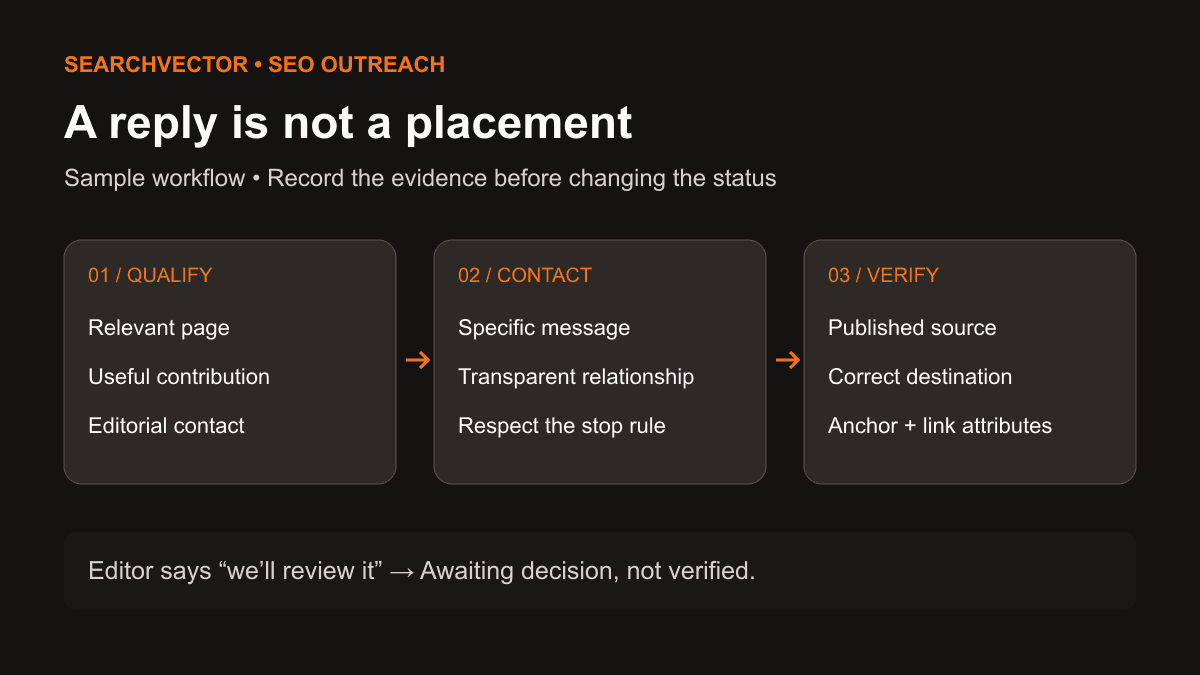
Google's link-spam policy covers buying or selling links for ranking purposes and excessive link exchanges. Paying to insert a link into an existing article does not escape that policy because someone calls it a niche edit. For outreach, offer genuinely relevant material and let publishers make editorial decisions; do not demand unqualified links as a condition.
Confirm changes before calling a link lost
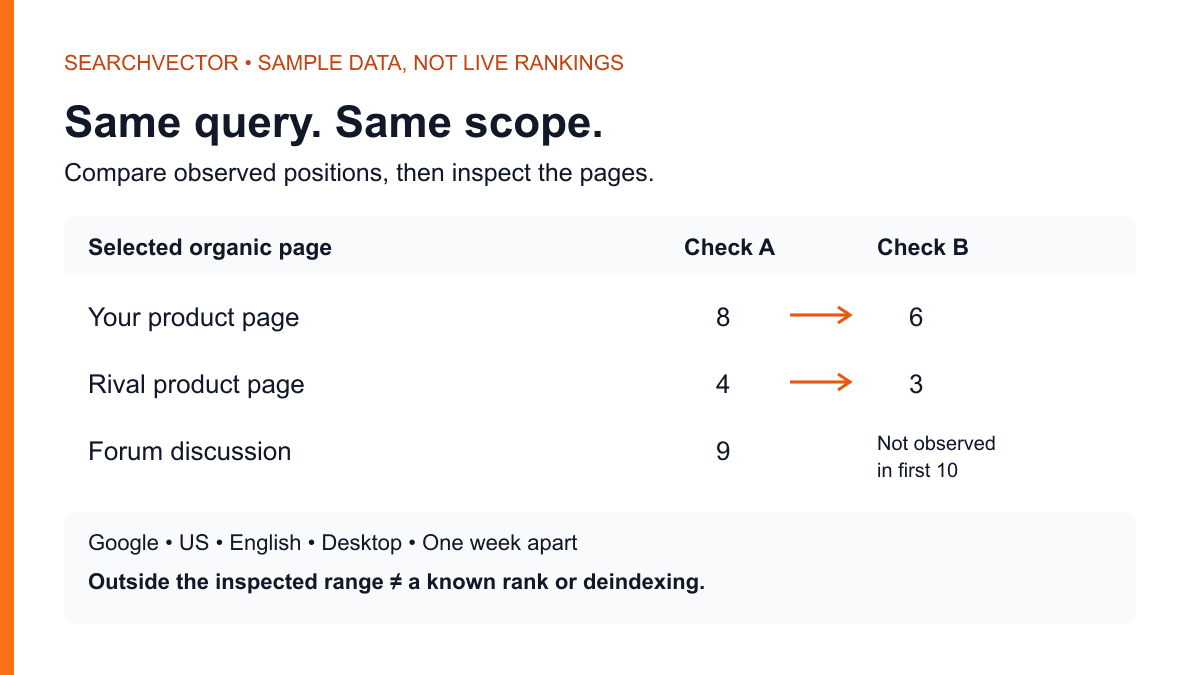
“First seen” usually describes a source's observation, not the publication date. A crawler may discover an old page today. Likewise, a link absent from the next export may be outside its current sample or filters. Compare the same scope and collection method before investigating the difference.
- Open the previously recorded source URL and follow any redirect.
- Look for the expected destination and anchor in the page's current context.
- Check whether the destination moved or the link relation changed.
- Record the inspection time and outcome: present, changed, removed or unable to verify.
- If access fails, retain the earlier evidence and schedule another inspection.
A timeout or access-denied response is not confirmation of removal. If a source page loads successfully and the expected link is absent, record that narrower finding. You still cannot infer when the publisher removed it from that observation alone.
Finish with a short, prioritized review record
For each finding, write: source, inspection date, observation, next action and owner. For the fictional directory entry, the observation is “linked destination returns not found”; the next action is “confirm the replacement URL.” This is more actionable than labeling the entire profile unhealthy.
- Fix reader journeys: investigate verified broken destinations and misleading anchors first.
- Resolve evidence gaps: recheck inaccessible pages and unknown link relations.
- Review policy concerns: investigate arrangements involving purchased ranking links or excessive exchanges.
- Develop useful resources: improve material that relevant publishers could reasonably cite.
Do not automatically disavow a list sorted by a vendor's risk score. Google's disavow guidance says most sites do not need the tool and warns that incorrect use can harm performance. It sets a much narrower case involving considerable artificial or low-quality links and a manual action, or a likely manual action.
For follow-up work, SearchVector's broken link checker is a related destination-checking resource; it should not be treated as a complete inbound-link inventory. When the gap is useful content rather than a broken URL, use keyword research to explore questions your next guide could answer.
Your final profile summary should state what you observed, where the data came from and what needs attention. In the sample, that means 12 links, four domains, a repeated club reference and one destination to investigate. The goal is a defensible next action, not a reassuring total.