
Niche edits are links added to articles that are already published, usually within a paragraph relevant to the linked resource. They are also called contextual link insertions or curated links. The important question is why the publisher is making the change: to improve the article for readers, or to sell a link intended to influence rankings?
A useful editorial update can introduce missing evidence, replace a dead citation, or point readers to a better explanation. Paying for an unqualified link is a different arrangement, even when the surrounding article is relevant. This guide walks through one fictional placement decision and the checks to make before proposing an edit.
What actually changes in a niche edit?
Four elements define the insertion: the existing source article, the sentence around the link, the visible anchor text, and the destination page. Review them together. A credible publisher does not make every page on its domain an appropriate source, and a relevant article does not make every destination useful.
For example, an article about inventory planning might reasonably cite a worksheet that helps a shop estimate reorder points. Linking the same sentence to a generic software homepage could leave the reader searching for the promised worksheet. The domain relationship is similar; the usefulness of the individual citation is different.
Unlike a guest post, a niche edit uses an existing article rather than a newly contributed one. Replacing a broken reference is one possible reason for an edit, but only if the replacement supports the original point. Adding a link between two pages you own is internal linking, with its own navigation purpose. None of these labels establishes the quality of a particular link.
Separate editorial judgment from paid placement
Google defines link spam around manipulation of search rankings. Its examples include buying links for ranking purposes, exchanges of goods or services for links, and excessive reciprocal linking. A site violating these policies may lose visibility or receive a manual action. An older article is not an exception. See Google's link spam policy.
Evaluate compensation before debating anchor wording. An insertion fee described as an editorial administration charge still needs scrutiny when the purchase secures a link. A requirement to link back also changes the arrangement. Relevance and publisher permission are necessary editorial checks, but neither makes an undisclosed paid ranking link acceptable.
| Relationship | Google's guidance |
|---|---|
| Ordinary editorial citation | No special rel value is required for a regular link. |
| Advertisement or paid placement | Use rel="sponsored"; rel="nofollow" remains acceptable. |
| User contribution, such as a forum comment | Use rel="ugc" for user-generated links. |
| Other link the publisher does not want associated with its site | Use rel="nofollow" when the other values do not apply. |
These recommendations come from Google's outbound-link qualification documentation. “Dofollow” is informal language, not a required HTML attribute. Do not ask an editor to strip qualification from a paid link. For sponsored content, make the commercial relationship clear to readers as well; an HTML attribute is not a visible explanation.
A worked example: the inventory worksheet
Suppose a fictional retail newsletter has an existing guide to avoiding stockouts. Your team has published an accessible worksheet with inputs, units, a formula and a completed example. No payment, product exchange or reciprocal link has been offered. You want to suggest it as a resource.
| Review item | Proposed decision |
|---|---|
| Existing passage | “Set a reorder point before stock runs out.” |
| Reader's missing step | How to turn demand and lead time into a usable threshold. |
| Suggested addition | “Use a reorder-point worksheet to document your assumptions.” |
| Anchor and destination | Link “reorder-point worksheet” directly to the worksheet explanation. |
| Editorial decision | Offer it for review; let the publisher revise, decline or select another source. |
The worksheet earns consideration because it answers the next question raised by that paragraph. Before sending it, check whether readers can understand the inputs without creating an account, whether the calculation is explained, and whether the example uses consistent units. If the resource is mostly a signup wall, improve it before asking for a citation.
Now change one fact: the publisher requests payment and guarantees an unqualified link. The reader benefit has not disappeared, but the commercial decision has changed. Do not proceed on those terms. A properly qualified sponsorship could be evaluated for its audience and referral value, separately from an earned citation.
A second variation also fails: the worksheet is useful, but the available article discusses restaurant decor. Do not add a tenuous transition just to fit the link. Find content where inventory is already the subject, or accept that this publisher has no suitable page.
Review the source before contacting its editor
Open the exact article and read the section above and below the proposed insertion. Then inspect several related pages. You are assessing editorial fit and stewardship, not looking for a single numerical score that makes the purchase safe.
- Reader fit: name the question the destination answers at this point in the article. If you cannot, stop.
- Destination value: confirm that the cited material exists, loads and supports the surrounding claim. Prefer the specific resource over a broad homepage.
- Source integrity: look for coherent subject coverage, identifiable editorial responsibility and working citations. Unrelated commercial insertions deserve investigation.
- Permission: contact someone authorized to edit the page. Decline offers involving compromised accounts, hidden injections or access without the owner's knowledge.
- Relationship: document payment, gifts, sponsorship or an exchange requirement before agreeing to the insertion.
- Wording: use an anchor that describes the destination naturally. Allow the editor to choose wording that fits the sentence.
A high third-party authority score cannot tell you whether the paragraph is useful or the publisher controls the page. Nor does an indexed source prove that a new insertion will deliver ranking gains. Avoid turning those observations into a pass/fail formula. Keep a short written reason for accepting or rejecting the opportunity.
Make a resource suggestion the editor can assess
A concise request should identify the existing passage, explain the missing information, and point to the exact resource. For the fictional example: “Your stockout guide recommends setting a reorder point. We published a worksheet that shows the inputs and an example calculation. If it helps that section, please consider citing it; you are welcome to choose the wording.”
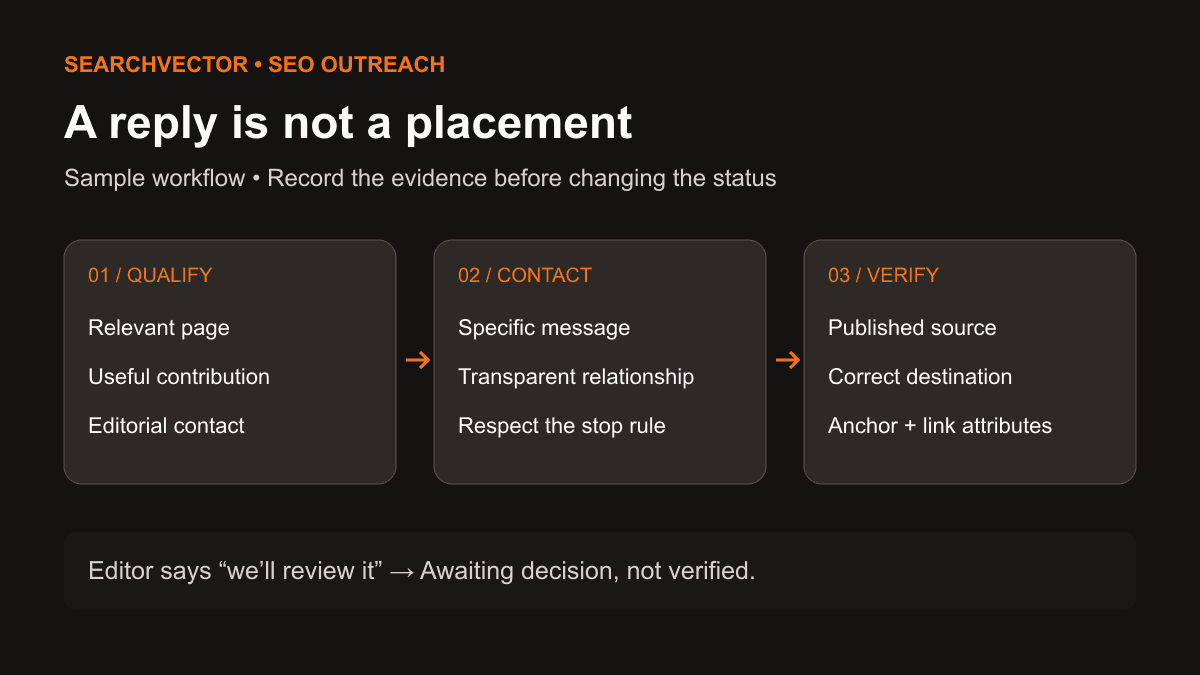
That message is a sample, not a proven outreach template. It makes the editorial choice explicit and avoids a demand for a particular anchor or link attribute. Do not turn silence into permission or repeatedly pressure an editor. If they decline, use the feedback to improve the resource rather than negotiating a disguised exchange.
Record the placement and check it manually
Once an edit is live, save the source URL, destination, anchor, publication date, surrounding sentence, observed rel values and any commercial relationship. Keep the editor's permission and your next review date alongside the record. A screenshot can preserve context, but it cannot prove the page remains unchanged later.
SearchVector's backlink records provide a place to document source and destination URLs, anchor text, planned and published dates, and notes. Use notes for the relationship and your manual observations. Record keeping is separate from discovery or automatic status monitoring: adding a record does not establish that the link has been crawled or verified.
At your chosen review interval, reopen the source. Confirm that the link remains in a sensible sentence, reaches the intended destination and retains the appropriate qualification. If it disappeared, first check whether the publisher revised the article. Ask for restoration only when the resource still belongs there. Preserve the history instead of overwriting an earlier observation with an unexplained status.
Decide what success means before counting links
Judge an editorial suggestion by whether it produced a useful citation on an appropriate page. If you have authorized analytics, review relevant referral visits and subsequent actions, with the date range and attribution limits recorded. A ranking movement after the edit does not isolate its effect from content changes, competitors or other search changes.
Sometimes the better next action is on your own site. Make the worksheet easier to find from related guides, and use SearchVector's Internal Links Checker as a starting point for reviewing that navigation. Assess each suggested connection yourself. An internal route to a resource helps your readers even when another publisher never links to it.
Should you pursue this niche edit?
Proceed with an editorial suggestion when the source has a real information gap, your destination fills it, and the publisher retains an independent choice. Evaluate a paid placement as advertising with appropriate qualification and clear expectations. Decline unauthorized access, concealed compensation and promises of guaranteed ranking credit.
Your next step is concrete: select one resource you can defend, identify one passage it genuinely improves, and write down the reason. If that reason depends mainly on the age of the article or a promised SEO boost, improve the resource or choose a different opportunity.