
SEO outreach is the process of contacting a relevant publisher with something useful for their readers: a source, a correction, research, or an editorial contribution. A link may follow, but the publisher decides whether the resource belongs in the article. A useful process starts with a reason to contact someone and ends with a verified record of what happened.
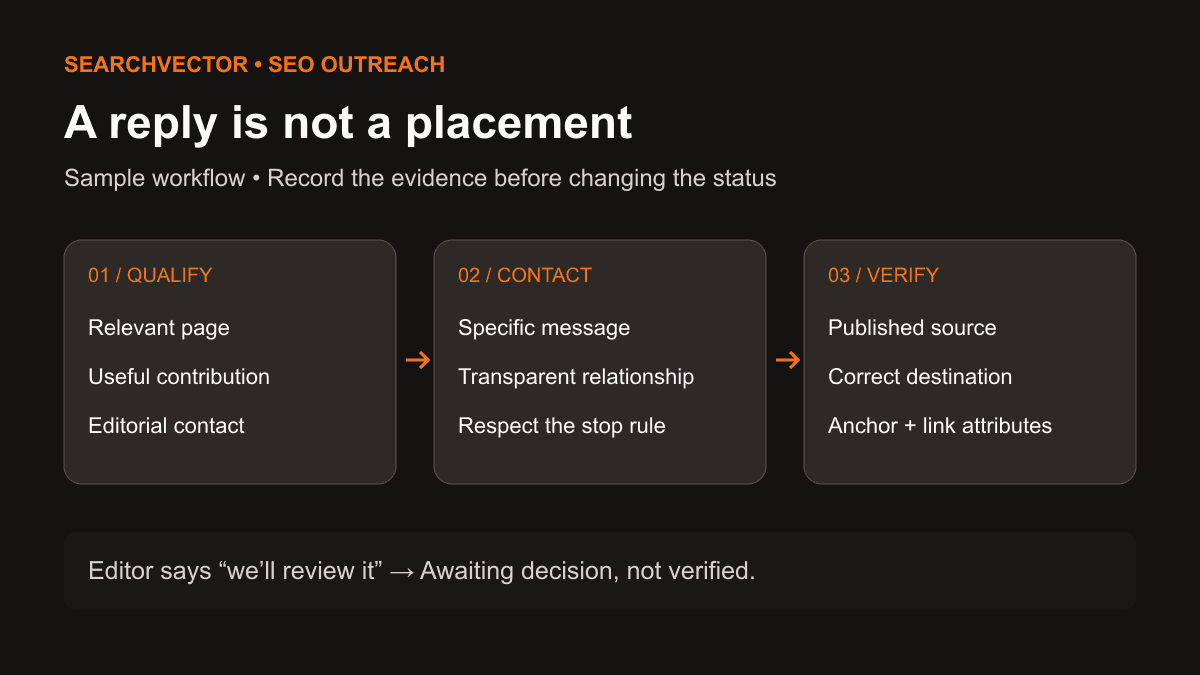
Use this five-part checklist for your next campaign: define the contribution, qualify the page, write a specific message, limit follow-up, and verify any placement. Keep correspondence separate from backlink records so a positive reply never becomes a reported link before publication.
Start with a contribution worth reviewing
Write one sentence explaining the reader's problem and what your resource adds. “We published another guide” is weak. “Our worksheet lets a reader compare three packaging materials using the same units” gives an editor something concrete to evaluate.
Useful reasons include correcting an outdated source, contributing an expert explanation, supplying original data with a clear methodology, or offering a practical resource that fills a specific gap. For broken-link outreach, open the cited destination and confirm the problem before suggesting your replacement. A temporarily unavailable page is not automatically obsolete.
Check your own destination first. It should load, answer the promised question, identify its author or organization, and explain its evidence. If you need to understand the language readers use, explore topics with SearchVector keyword research. Then read the prospective publisher's article. Keyword overlap alone does not establish editorial fit.
Qualify the page before finding a contact
Review a small batch manually before expanding your list. Save the exact article URL and the paragraph where your resource could help. Domain-level metrics can provide context, but they cannot tell you whether that paragraph needs another citation.
| Check | Keep or reject? |
|---|---|
| Reader fit | Keep when the article serves the audience your resource helps. |
| Specific contribution | Keep when you can explain a missing detail or useful correction. |
| Editorial activity | Check whether the publication maintains relevant content and identifies responsible editors. |
| Contact route | Use the published editorial address or submission form and follow its instructions. |
| Relationship terms | Reject a requirement to buy an unqualified ranking link or participate in a link scheme. |
Record a short rejection reason. “Wrong audience” and “no useful addition” are better than silently deleting rows because they reveal whether your research method is finding suitable pages. Avoid treating a new, specialist publication as worthless simply because it has a low third-party authority score.
A publicly visible address is not an invitation to send irrelevant campaigns. Honor submission rules, refusals, and requests to stop. Do not route the same pitch through multiple employees after one editor declines it.
Worked example: a packaging worksheet pitch
The following scenario and message are fictional teaching examples. No messages were sent and no placements were obtained. Imagine a small packaging consultancy has created a worksheet comparing packaging weight per shipment. It includes definitions, calculation steps, and limitations, with no unsupported environmental claims.
The researcher considers three pages: a retailer's promotional announcement, a trade publication's practical packaging guide, and a general directory selling links. The practical guide explains material choices but lacks a worked calculation. That makes it a candidate for review. The announcement has no relevant gap; the paid-link directory fails the relationship check.
The proposed addition is narrow: a source readers can use to calculate packaging weight consistently. The researcher reads the publication's submission page, identifies its editorial contact route, and checks that the worksheet is available without a signup barrier.
Subject: Calculation example for your packaging guide
Hello Editorial Team,
Your guide explains how to compare packaging materials. The section on shipment weight could also use a worked calculation showing how to include the box and protective fill.
I work with the consultancy that created a worksheet for that calculation. It states the units and assumptions and includes an example readers can repeat. Would it be useful for your next update? I can send the worksheet and methodology for review.
There is no requirement to include it or link to us. If this is outside your coverage, I will close the request.
This example asks permission to send the resource; it does not invent a downloadable URL. In a real pitch, include the genuine resource link when the publication's submission instructions request it. Identify your organization and relationship clearly. Skip invented familiarity, exaggerated praise, and promises that your resource will improve the publisher's rankings.
Choose tools for each part of the job
A small campaign can run with public search, a browser, a spreadsheet, and an ordinary inbox. Add software when a specific bottleneck appears. More sending capacity will not fix a list of poorly matched pages.
| Task | Tool and boundary |
|---|---|
| Research the resource | Keyword research plus source reading. Search demand is context, not proof an editor wants a pitch. |
| Qualify publishers | Public search and manual page review. Confirm editorial relevance yourself. |
| Manage correspondence | An inbox and spreadsheet, or a CRM. Track ownership, replies, and requests to stop. |
| Document a placement | SearchVector backlink records can hold source, destination, anchor, dates, and notes. |
| Recheck a placement | Open the source page again and log the observation. A saved record is not proof of an automatic recheck. |
Before adopting dedicated outreach software, test whether it prevents duplicate contact, lets your team stop a sequence after a reply, preserves suppression decisions, and exports the records you need. These are selection criteria, not claims that every product provides them. Check the vendor's current documentation and test with addresses you control.
SearchVector's backlinks page is a relevant next step for organizing backlink work. Its manual placement records should not be treated as an outreach inbox, contact-discovery service, or email-sequence system.
Use a ledger with clear stop conditions
Give each prospect one owner. Your correspondence ledger should contain the page URL, reason for contact, public contact route, message date, latest reply, next action, and a do-not-contact flag. Store only the information needed for the task and restrict access to your team.
Choose your follow-up policy before sending. A conservative starting point is one short follow-up after roughly a working week, unless the publisher asks for a different timeline. This is an editorial operating suggestion, not a universal response-rate formula. Add genuinely useful context, then close an unanswered request. A refusal or stop request ends follow-up immediately.
Use distinct states: qualified, contacted, replied, awaiting editorial decision, declined, closed without reply, and placement verified. An editor saying “we will look at it” belongs in awaiting decision. An automated receipt does not count as a substantive reply.
In a fictional batch of ten contacted prospects, suppose three send substantive replies and one placement is verified. The reply rate is 3 ÷ 10 = 30%; the verified-placement rate is 1 ÷ 10 = 10%. These are sample arithmetic, not benchmarks or SearchVector results. Keep the batch and observation window consistent. One placement from a small batch cannot establish a reliable expected return.
Verify the link and its editorial context
After an editor reports publication, open the source page. Confirm the surrounding text describes your resource accurately, the link reaches the intended destination, and its anchor is understandable. Record the source URL, destination, anchor, publication date if known, and the date you personally checked it. If the publication date is unknown, leave it unknown rather than substituting your inspection date.
Check the link's HTML attributes too. Google recommends rel="sponsored" for advertising and paid placements, and accepts nofollow for that purpose. It recommends ugc for user-generated links such as comments and forum posts. Ordinary editorial links do not need a special “dofollow” attribute. See Google's outbound-link qualification guidance.
Google's link-spam policy covers buying or selling links for ranking purposes, excessive exchanges, and other manipulative linking practices. Calling a paid insertion a “niche edit” does not change its purpose. Do not make reciprocal links or unqualified paid links a condition of an outreach agreement.
A link can be useful to readers without passing ranking credit. Keep referral visits and business inquiries separate from placement counts, and use analytics you are authorized to access when measuring them. A rise in rankings after outreach does not, by itself, prove the placement caused it.
Finish with one reviewed batch
Choose one strong resource and review ten potentially relevant pages. Keep only prospects where you can explain a useful addition in one sentence. Send a specific, transparent pitch through the appropriate route, assign one owner, and respect the stopping rule.
At the review date, inspect both outcomes and rejection reasons. Many mismatched prospects point to a research problem; interested editors who cannot use the resource point to a content problem. Improve that step before increasing volume. Document a backlink only after checking the published page, and retain the evidence needed to check it again.