
Travel SEO helps people find your destination guides, itineraries and bookable services through search. Those pages serve different decisions: where to go, how to organize a trip, and which operator to book. Start by matching each decision to a useful page, then plan updates around when people research and reserve, not just when they travel.
This guide includes a seasonal planning worksheet (CSV) and a fictional coastal tour example. The sample months are planning assumptions, not measured demand, destination advice or customer results. Replace them with evidence from your own market.
Give each travel decision a home
A small operator does not need a page for every keyword variation. It needs distinct answers to the questions that affect a purchase. Begin with one destination and the experiences you actually provide. List questions from inquiries, support conversations and your existing search data; remove personal details before sharing research with writers.
| Traveler question | Page and useful answer |
|---|---|
| Where should we stay? | Destination guide: compare areas, transport and tradeoffs. |
| Can we explore in three days? | Itinerary: sequence activities, allow transfer time and offer alternatives. |
| Which guided walk can we book? | Service page: route, duration, inclusions, meeting point and booking action. |
| What happens if the weather changes? | Practical answer: explain the operator's actual cancellation or rescheduling policy. |
Use SearchVector keyword research to explore wording around those questions. Review the search results yourself to see whether guides, maps, operator pages or large booking platforms dominate. A broad destination query may need an independent planning guide; adding that phrase repeatedly to a checkout page will not supply the missing answer.
Group close variations when they ask the same question. Separate a self-guided itinerary from a paid walking tour when the experience and next action genuinely differ. Publishers can use the same map, with a clear editorial recommendation or disclosed affiliate link instead of an operator's booking button.
Work backward from the research window
Keep three dates separate: when people investigate a destination, when they reserve, and when they arrive. Booking records show reservations and travel dates, but usually cannot tell you when research began. Search trends can help frame that earlier window without proving that the same people later purchased.
Compare several years where available, keeping country, query and time range consistent. Watch for movable holidays, one-off events and changes in your own inventory. Google Trends uses sampled, normalized data; its 0–100 scale represents relative interest, not monthly search counts or booking demand. A peak is a prompt to investigate, not a revenue forecast.
Choose an editorial deadline before the observed research rise, leaving time for verification, publishing and discovery. There is no universal number of weeks that guarantees rankings. A newly created site and an established destination guide have different starting points.
Worked example: one season, three page jobs
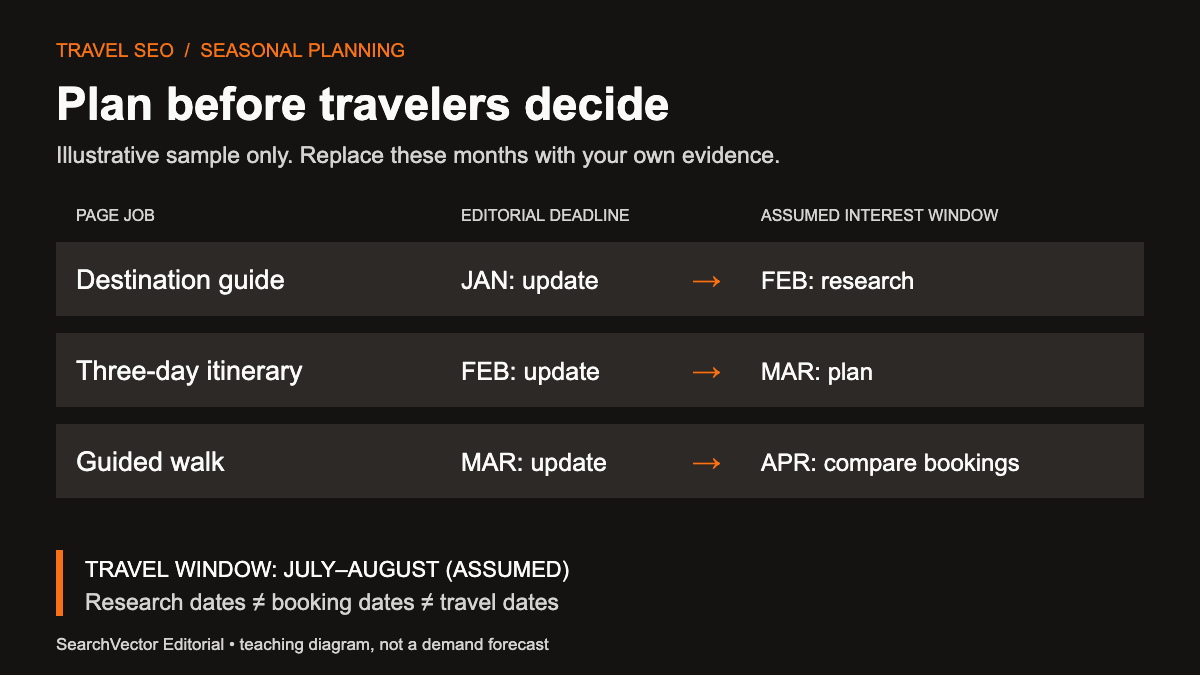
Imagine a fictional operator offering coastal walks during July and August. For this exercise only, assume destination research rises in February, itinerary planning in March and booking comparisons in April. The operator has one editor and chooses to improve three existing pages rather than launch twenty similar articles.
| Page job | Assumed interest | Editorial action |
|---|---|---|
| Destination guide | February research | January: verify transport and area comparisons. |
| Three-day itinerary | March planning | February: check route order, duration and alternatives. |
| Guided walk | April booking | March: confirm inclusions, policies and booking path. |
The guide should help a reader choose a base, then link to the itinerary where a three-day stay makes sense. The itinerary should explain where a guided walk fits and link to the specific service. The service page should let the visitor confirm suitability and take the next step. Each link advances a decision; none needs a forced exact-match anchor.
The downloadable worksheet contains three labeled sample rows and four blank planning rows. Record the audience market, travel window, research and booking windows, target page, evidence, update deadline, owner and next review. The row-type column separates examples from your plan. Do not treat a suggested month as a publishing obligation when your evidence points elsewhere.
Make the page useful enough to choose a trip
Replace interchangeable destination prose with details that change a decision. For a walking itinerary, explain the start and finish, realistic pacing, rest opportunities and an alternative for someone who cannot complete the route. Verify accessibility details with the relevant venue or operator instead of assuming that a photograph establishes step-free access.
Use firsthand material when you have it, and identify who observed what and when. If an editor has not visited, say how the information was checked rather than inventing a field report. Google's people-first content guidance emphasizes original value, clear sourcing and useful experience. Adding an author badge alone does not replace that evidence.
- Stable guidance: explain the route's purpose, neighborhood tradeoffs and who the experience suits.
- Changing details: check opening hours, transport schedules, admission conditions and operator policies against current primary sources.
- Commercial details: distinguish what is included from optional costs, and direct readers to the actual booking source for current availability.
- Maintenance: assign someone to recheck important details before the research window and after a reported change.
Show a meaningful checked date where changing facts warrant it. Update the facts before changing the date. Use original route photographs or clearly labeled diagrams with useful alternative text; avoid presenting stock images as evidence of a visit. On mobile, check whether a traveler can find the meeting point and cancellation terms without dismissing several overlays.
Keep destination pages discoverable without multiplying duplicates
Build a browsable hierarchy from destination to itinerary or service. Link important pages from relevant hubs and use descriptive page titles. A fictional title such as “Three-day coastal itinerary: walks and rainy-day alternatives” sets a clearer expectation than “Best amazing travel experiences.” Keep the visible heading aligned with the page's actual answer.
Booking sites can generate many URLs for dates, guests, sorting and campaign parameters. Inventory those variations before deciding what should be indexable. An equivalent tracking URL and a genuinely different destination are different problems. Google's canonicalization guidance explains how to signal a preferred URL among duplicate or very similar pages. A canonical is a signal, not a guarantee; do not point unrelated trips to one generic destination page.
Use SearchVector's sitemap analyzer when reviewing your sitemap, then compare its listed URLs with the pages you intend visitors to find. Sitemap inclusion alone does not establish indexing. Use the SEO site audit as another review entry point, and verify identified issues on the affected page before assigning a fix.
For translated guides, provide a separate accessible URL for each language and a visible language switch. Use hreflang to identify corresponding language or regional versions. Translate practical and booking information as well as navigation. Google's international site guidance recommends separate language URLs and cautions against automatic language redirects that prevent access to other versions.
Earn attention through local usefulness
An accurate route guide, an original accessibility explanation or a well-maintained transport resource can give local organizations a reason to reference your site. Contact an appropriate partner with the specific resource and let them make an editorial decision. Check that your business details and contact information are consistent wherever your services are listed.
Do not turn partnerships into a required link exchange or buy links that pass ranking credit. Google's spam policies cover paid ranking links and excessive reciprocal linking. Paid or sponsored placements should be qualified appropriately, such as with rel="sponsored" or rel="nofollow". A useful partnership can bring readers without a promise of ranking gains.
Measure the next decision, then choose one update
Review destination guides, itineraries and service pages separately. In your own Search Console property, compare queries and pages across consistent dates, countries and devices. Its Performance report provides search clicks, impressions, click-through rate and position. It does not establish completed bookings or trip revenue.
Consider a fictional review where a destination guide attracts more search clicks but service-page visits stay flat. First check whether the new queries concern the trips you sell. Then inspect whether the itinerary link is relevant and easy to find. If people reach the service page but abandon the booking step, investigate availability messaging and usability with your own analytics and booking records. Do not diagnose every loss as a keyword problem.
Compare equivalent seasonal periods where possible, and annotate closures, price changes or a new booking system. Treat attribution as a separate measurement task, especially when reservations happen on another domain. Agree on what counts as an inquiry or completed booking before reporting results, and keep cancellations separate from gross reservations.
Start this week with one destination, one travel window and one page that blocks the next decision. Fill in the worksheet, verify the page's changing facts, improve its next-step link and set a review date. A maintained path from research to a suitable trip is a stronger operating plan than a large queue of disconnected travel articles.